
1974 Stanley Cup Final
Flyers became first 1967 expansion team to win Stanley Cup.
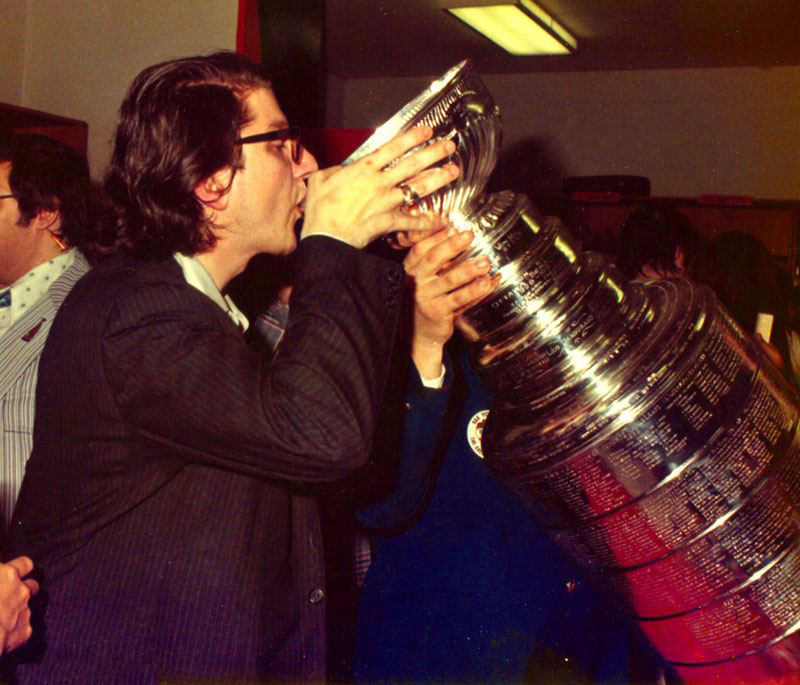
The 1974 Stanley Cup Final determined the NHL champion for the 1973–74 season, capping off that year's playoffs. The Boston Bruins faced the Philadelphia Flyers. This marked the Flyers' first trip to the Final, while the Bruins were making their third appearance in five years, having won the Cup in 1970 and 1972. Philadelphia won the best-of-seven series four games to two. With the victory, the Flyers became the first franchise from the 1967 NHL expansion to win the Stanley Cup. They were also the first non-Original Six champion since the Montreal Maroons in 1935, and the first non-Original Six team to reach the Final since the league stopped guaranteeing a spot for such teams after Chicago switched divisions in 1970.
Boston reached the Final by sweeping the Toronto Maple Leafs 4–0 and then defeating the Chicago Black Hawks 4–2. Philadelphia advanced by sweeping the Atlanta Flames 4–0 and edging the New York Rangers 4–3.
Coming into the series, the Flyers had lost 17 and tied two of their previous 19 games in Boston. The Bruins boasted the league's best regular-season record, finishing one point ahead of the Flyers, and held home-ice advantage, making them heavy favorites. A key confidence boost for Philadelphia came late in the regular season when they beat the Bruins 5–3 at the Spectrum.
In Game One, the Flyers nearly scored late in the third period to break a 2–2 tie. Bobby Orr saved the potential goal by blocking the open Boston net with his leg, then carried the puck up ice and fired a slapshot past goaltender Bernie Parent with just over a minute left, giving the Bruins a 3–2 win.
Game Two saw Boston on the verge of a 2–0 series lead when Flyers defenseman Andre Dupont scored with Parent pulled for an extra attacker, tying the game 2–2 with less than a minute remaining. Bobby Clarke then scored the 3–2 overtime winner. It was the Flyers' first win at Boston Garden since the two franchises first met.
In Game Three, Bernie Parent's goaltending led Philadelphia to a 4–1 victory. Parent continued his strong play in Game Four, stopping 28 shots in a 4–2 win that gave the Flyers a 3–1 series lead.
Game Five in Boston was a chaotic affair marred by fights and penalties, with the Bruins winning easily to force a Game Six in Philadelphia.
On May 19, in front of a national NBC audience and a raucous Philadelphia crowd, Parent posted a 30-save shutout. The
- Series winner
- Philadelphia Flyers
- Series runner-up
- Boston Bruins
- Games played
- 6
- Winning goal (game six)
- Rick MacLeish
- Conn Smythe Trophy winner
- Bernie Parent
- First expansion team to win Cup
- Yes
Lore & Background
The Flyers took a 3–1 series lead behind strong goaltending from Bernie Parent, who stopped 28 shots in game four. Boston won game five in a sloppy affair marred by many fights and penalties. On May 19, before a national audience on NBC and a raucous Philadelphia crowd, Parent posted an epic 30-save shutout as the Flyers won 1–0 on a lone goal by former Bruin draft pick Rick MacLeish. Parent made a spectacular kick save to stop a slapshot from Ken Hodge with less than three minutes left. Parent was named Conn Smythe Trophy winner as playoff MVP. The Flyers were the first team to clinch the Stanley Cup at home since the Bruins did so four years earlier on Orr's famous overtime goal.
Reader's Guide
The 1974 Stanley Cup Final marked a turning point in NHL history. The Philadelphia Flyers became the first team from the 1967 expansion to win the championship, breaking the dominance of the Original Six franchises. Their victory ended a 39-year drought for non-Original Six teams, dating to the Montreal Maroons in 1935. The series is remembered for Bernie Parent's goaltending, which earned him the Conn Smythe Trophy, and for Bobby Clarke's overtime winner in game two that shifted momentum. The Flyers' win triggered the largest celebration in Philadelphia sports history, with more than two million lining Broad Street for a ticker-tape parade. The following year, the Flyers successfully returned to the Finals and captured their second consecutive Stanley Cup over the Buffalo Sabres. The Bruins, after losing the Final, were eliminated in the first round by the Chicago Black Hawks. The Stanley Cup was not won on home ice again until the Canadiens did so in 1979.
Did You Know?
- The Flyers were the first team from the 1967 Expansion to win the Stanley Cup.
- Bernie Parent recorded a 30-save shutout in game six and won the Conn Smythe Trophy as playoff MVP.
- The Flyers' Stanley Cup win triggered the largest celebration in Philadelphia sports history, with over two million people lining Broad Street for a parade.
- The Stanley Cup was not won on home ice again until the Canadiens did so in 1979.
Defining Moments of a Five-Game Classic
The 1990 Stanley Cup Final delivered drama that echoed through hockey history. Though the Edmonton Oilers ultimately claimed the title in five games, the Boston Bruins controlled much of the early action, holding a 15-4 shot advantage at one point in Game 2 before Edmonton mounted a comeback. The series opener remains etched in record books: Petr Klima buried the winning goal at 15:13 of the third overtime period, giving Edmonton a 3-2 victory in what stands as the longest game in Stanley Cup Final history, edging out both Brett Hull's 1999 winner and Igor Larionov's 2002 goal by less than thirty seconds. The series concluded on May 24 at Boston Garden, where the Oilers dispatched the Bruins 4-1 behind a Craig Simpson game-winner. It marked the first time Edmonton had ever clinched a Cup on the road. Backup goaltender Bill Ranford, who had stepped in for the injured Grant Fuhr for the remainder of the regular season and the full postseason, collected the Conn Smythe Trophy as playoff MVP.
Messier's Captaincy and the Post-Gretzky Dynasty
This championship represented the fifth Stanley Cup for Edmonton in a span of seven years, yet it carried a bittersweet significance: it was the only title the organization would capture after sending Wayne Gretzky to the Los Angeles Kings during the 1988 off-season. The 1990 series served as a rematch of the 1988 Finals, but without the league's most iconic player on the ice. For captain Mark Messier, lifting the Cup in 1990 was his first as a team leader and his fifth overall. Four years later, he would captain the New York Rangers to their 1994 championship and score the decisive goal, making him the sole player in NHL history to lead two different franchises to the title. Grant Fuhr, limited to just 21 regular-season games by injury, missed the entire playoffs yet still qualified for the Cup engraving by having dressed for over 40 games. The Oilers would not return to the Finals until 2006, when they fell in seven games.
The End of an Era at Boston Garden
The 1990 Final carried a quiet historical weight for Boston. Game 5, played on May 24 at Boston Garden, would prove to be the last Stanley Cup Final game ever held at that legendary venue. For the Bruins, the loss marked the beginning of a 39-year absence from the championship round that would not end until their 2011 title run. Their path to the Final had been impressive, dispatching the Hartford Whalers 4-3, the Montreal Canadiens 4-1, and the Washington Capitals 4-0, yet the series ultimately slipped away. Defenseman Ray Bourque, a cornerstone of Boston's blue line, would not taste another Finals appearance until the Colorado Avalanche's 2001 championship. The Oilers, meanwhile, dominated all three games played at Boston Garden across their Finals history, winning each road contest despite having claimed only one game away from their home Northlands Coliseum in their previous Finals victories. The contrast between the two franchises' trajectories after 1990 would define the next two decades of NHL history.
Western Canadian Supremacy and the Road to the Cup
The 1990 championship capped an extraordinary streak of Western Canadian dominance in the NHL's highest stakes. Edmonton's victory represented the eighth consecutive Stanley Cup Final contested by an Alberta-based team and the ninth in a row by a Western Canadian franchise. Over that remarkable stretch, the Oilers appeared in six of those Finals, the Calgary Flames in two, and the Vancouver Canucks in one. Edmonton's route to the 1990 title required navigating through the Winnipeg Jets in a hard-fought 4-3 first-round battle, sweeping the Los Angeles Kings 4-0 in the second round, and then dispatching the Chicago Blackhawks 4-2 in the Conference Final. The Oilers' dominance in this era also produced remarkable individual milestones: Garnet "Ace" Bailey collected his seventh Stanley Cup, though his name appeared on the trophy only five times due to varying engraving conventions across the years. Two European imports, Vladimir Ruzicka and Anatoli Semenov, joined the roster late in the season and received Cup rings despite not qualifying for the engraving.
Gallery
More in Boston Bruins games 1-18
Spotted an error? Know more?
This is a living reference — every entry is fact-audited, and reader corrections feed straight into our audit queue. Suggest an edit · See this site's audit record