
1972 Stanley Cup Final
Bruins beat Rangers in six games for second Cup in three years.
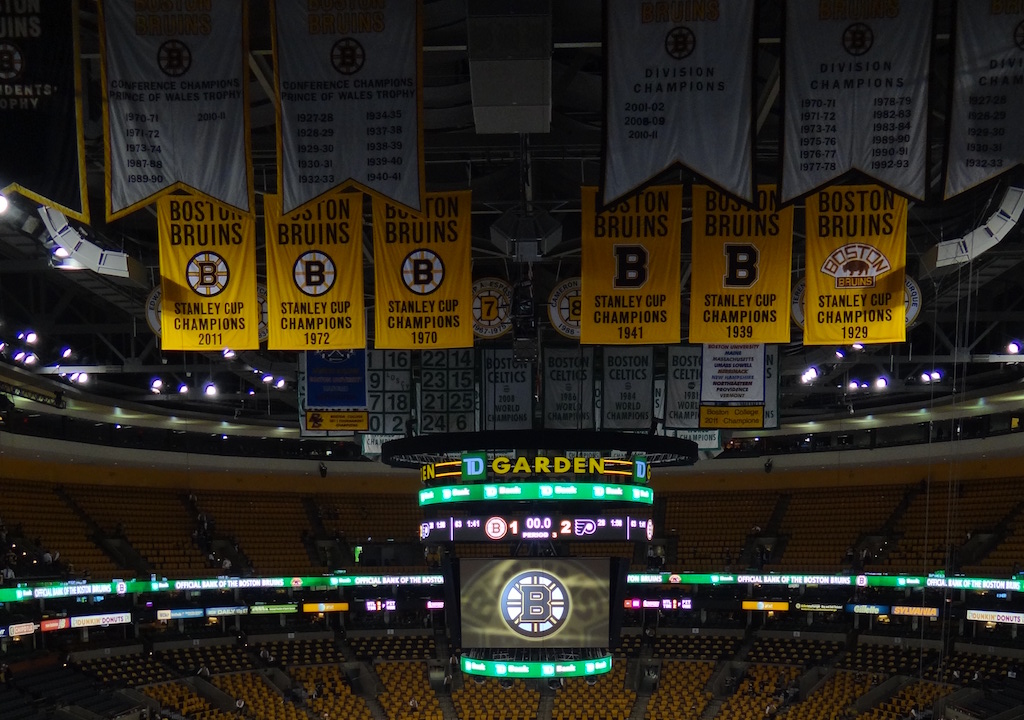
The 1972 Stanley Cup Final was the championship series of the National Hockey League's 1971–72 season, contested between the Boston Bruins and the New York Rangers. It was the Rangers' first appearance in the finals since 1950 and the Bruins' first since their victory in the 1970 Finals. The Bruins defeated the Rangers in six games to win their second Stanley Cup in three years, marking the last time the Bruins won the Cup until 2011.
- Series result
- Boston Bruins defeated New York Rangers 4–2
- Conn Smythe Trophy winner
- Bobby Orr (Bruins)
- Bruins captain
- None (team had no formal captain)
- Rangers goalie appearances
- Ed Giacomin and Gilles Villemure
- Bruins goalie appearances
- Gerry Cheevers and Eddie Johnston
Lore & Background
The 1972 Final was the second Boston-New York championship series, the first being the 1929 Stanley Cup Final. The Rangers hosted all their home games at Madison Square Garden, only the second time they did so in a Final; earlier Finals had been disrupted by a circus at the Garden, forcing neutral-site games. The Bruins advanced by defeating the Toronto Maple Leafs in five games and sweeping the St. Louis Blues, while the Rangers beat the defending champion Montreal Canadiens in six games and swept the Chicago Black Hawks.
Reader's Guide
The 1972 Stanley Cup Final is notable for several historical distinctions. Bobby Orr won the Conn Smythe Trophy for the second time, scoring the Cup-clinching goal in game six—his second such goal, having done the same in 1970. Phil Esposito took 41 shots in the series but was held without a goal. The Bruins became the most recent team to win the Cup without a formal captain; John Bucyk, as senior alternate captain, accepted the trophy. The series also featured a broadcasting oddity: in the United States, CBS chose not to televise game five, a potential clincher for Boston, but the Rangers won, allowing CBS to air game six. The Stanley Cup engraving mistakenly spelled the team name as 'BQSTQN BRUINS' with two Qs, an error later corrected on the replica Cup. Every player engraved had previously appeared on the Cup, a feat that had occurred only once before (1960) and has not happened since.
Did You Know?
- Bobby Orr tallied 4 goals and 4 assists in the series and won the Conn Smythe Trophy for the second time.
- The Bruins' name was misspelled as 'BQSTQN BRUINS' on the Stanley Cup engraving.
- This was the last time the Bruins won the Stanley Cup until 2011.
- The Rangers hosted all their home games in a Final for only the second time, the first being in 1929.
The Post-Gretzky Dynasty
The 1990 Stanley Cup Final represented something remarkable in hockey history: the Edmonton Oilers capturing their fifth championship in seven years, and doing so without their most iconic player. Wayne Gretzky had been dealt to the Los Angeles Kings during the 1988 off-season, making this series a rematch of the 1988 Finals minus the league's greatest star. Despite that absence, Edmonton once again overcame Boston, this time in five games. The achievement was particularly significant because it stood as the team's sole championship after Gretzky's departure. The broader context was equally staggering—this marked the eighth consecutive Stanley Cup Final featuring a team from Alberta and the ninth in a row for a Western Canadian franchise. Edmonton had appeared in six of those eight, with the Calgary Flames accounting for two and the Vancouver Canucks for one. It was a testament to a dynasty that had defined an entire era of professional hockey.
The Longest Final in History
Game One of the 1990 Stanley Cup Final will be remembered as the longest game ever played in a championship series. The contest stretched into triple overtime, with Petr Klima finding the net at 15:13 of the third extra period to seal a 3-2 victory for Edmonton. That goal edged out Brett Hull's 1999 Cup-winning score and Igor Larionov's 2002 game-winner by less than thirty seconds, cementing its place in the record books. The marathon duration underscored how tightly contested the opener was, with both teams trading blows across regulation and two full overtime periods. It set the tone for a series that, despite Edmonton's ultimate five-game triumph, was far from a foregone conclusion. The Bruins actually dominated much of the early series, holding a 15-4 shot advantage at one point in Game Two before the Oilers rallied. That Game One overtime thriller remains a landmark moment in championship hockey history.
A Farewell to Boston Garden
Game Five on May 24, 1990, carried a dual significance that transcended the scoreboard. Edmonton defeated Boston 4-1 to claim the Cup, marking the first time in franchise history they had clinched a championship on the road. In their previous Finals victories, the Oilers had managed to win only one game away from Northlands Coliseum each time, making this road sweep of Boston a notable milestone. Craig Simpson scored the decisive goal. Perhaps more poignantly, this contest was the final Stanley Cup Final game ever played at the Boston Garden, a venue that had hosted decades of championship hockey. On the individual level, goaltender Bill Ranford—originally the backup who had taken over from Grant Fuhr for the remainder of the regular season and the entire postseason—was named the Conn Smythe Trophy winner as playoff MVP. His performance anchored a defense that shut out Boston in the decisive game, capping a remarkable run for a team that had weathered the loss of its legendary franchise player.
Echoes of a Dynasty
The 1990 Final left lasting ripples across the NHL landscape. For the Bruins, it was their last appearance in the championship round until 2011, when they finally broke a 39-year Stanley Cup drought. Defensively, Ray Bourque would not reach another Final until the Colorado Avalanche's 2001 title run. Edmonton, meanwhile, would not return to the Finals until 2006, when they fell in seven games. Mark Messier's achievement in 1990 was particularly enduring: it was his first Cup as a team captain and his fifth overall. Four years later, he captained the New York Rangers to their 1994 championship and scored the Cup-winning goal, becoming the only player in history to lead two different franchises to the title. The engravement process also told a story—Garnet "Ace" Bailey collected his seventh Cup but had his name etched only five times, appearing under different name variations across the years. Players like Vladimir Ruzicka and Anatoli Semenov, who joined Edmonton from Europe late in the season, received rings but did not qualify for engravement.
Gallery
More in Boston Bruins games 1-18
Spotted an error? Know more?
This is a living reference — every entry is fact-audited, and reader corrections feed straight into our audit queue. Suggest an edit · See this site's audit record